
Colorado
What Is That HOA Fee Actually Paying For?
How I work through the monthly fee, the documents and the questions that could change my mind.
Jackson Granger · · 4 min read

Once an HOA fee gets above $400 a month, it catches my attention. My first reaction is that it can feel like paying rent on something you already own.
That is my reaction, not a rule about what an HOA should cost. I believe a well-run association can benefit everyone in the community. If I understand what the money is doing and the explanation makes sense, my opinion can change.
My eye usually goes to the amenities first. Is there a pool? A community center? With a luxury condo offering concierge service, I can picture what some of that money buys. For another property, I want to understand what justifies the monthly commitment.
Then I want to look at the responsibilities that don't show up in the listing photos.
What would I otherwise pay for myself?
Imagine two homes that fit your needs. One has dues of $350 a month; the other, $550. These are hypothetical figures. The difference is $2,400 a year.
Before deciding whether that difference makes sense, I would want to know whether we are comparing the same expenses.
HOA fees may include landscaping, exterior maintenance, water or sewer service. Fannie Mae's housing-cost guide identifies these as possible inclusions. I would ask which apply to each property and what the owner pays separately.
Then there is the question of personal value. Would I use the pool? Would having snow removal handled make life easier? A service can be valuable to one household and largely irrelevant to another.
That gives me a starting picture. If a client is seriously considering the property, I want to see whether the documents support it.
Read the HOA Fee in Three Parts
Compare what is covered, what is planned and what you still owe.
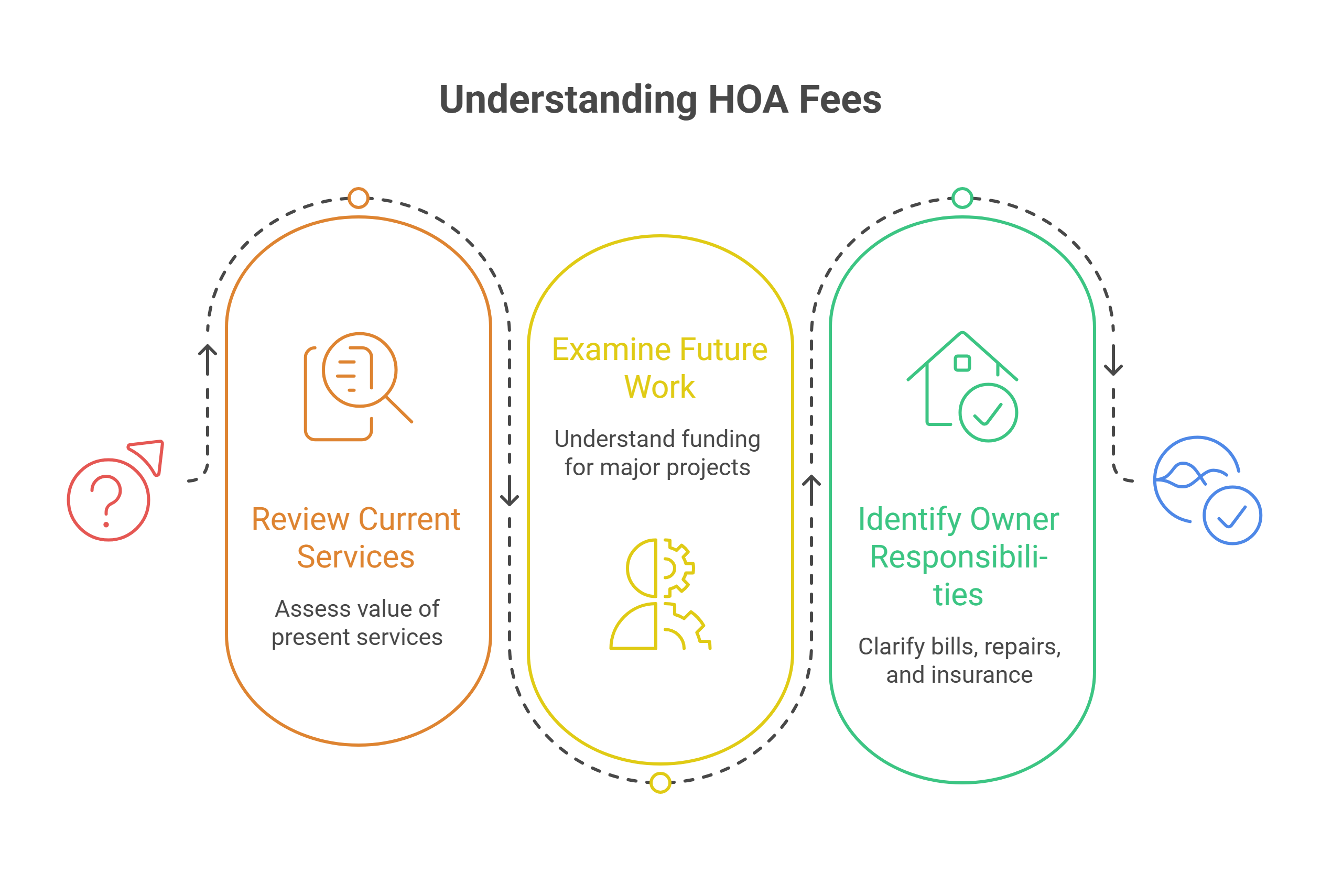
The three-step framework begins by reviewing current services and their value, then examines future work and funding for major projects, and finally identifies the owner's remaining bills, repairs and insurance responsibilities.
Getting the documents before an offer
As part of my service to buyers considering an HOA property, I use Association Online to help gather available association documents before we make an offer. Its document services include access to covenants, bylaws, financial statements and meeting minutes.
I want that information early enough to help us decide how to proceed. What does the association handle? What expenses are coming? What needs a clearer explanation?
For a Colorado property, I would start with the declaration and current budget. The state's guide to governing documents explains how the declaration establishes the community's framework, with rules and policies providing more detail. I would look for how responsibilities are divided between the association and the owner, then compare that with what the budget funds.
The documents available at that stage may leave gaps. I would identify what is missing and seek clarification, rather than treat the packet as a complete answer.
What is the association preparing for?
The next thing I would want to understand is how the association plans for major work.
Reserves are funds set aside for future expenses. A special assessment is an additional charge that may help cover a major expense or supplement those reserves. Fannie Mae's HOA guide explains both.
A reserve balance would not tell me much until I understood what it needed to pay for.
I would request the latest reserve study, if available. Fannie Mae's reserve-study guidance describes an assessment of major components, their remaining useful life, expected costs and a funding plan. I would use those categories to organize my questions, without treating a lending standard as a guarantee of financial health.
What work is expected next? How recent are the estimates? Does the current budget follow the funding plan? Do meeting minutes or project notices raise something we haven't accounted for?
If the answers don't line up, I would ask the association to explain. Depending on the question, we may need an accountant, engineer or attorney to help us understand the implications.
What does “insurance included” leave out?
This is another place I would slow down. Association insurance and an owner's individual coverage can serve different responsibilities. Fannie Mae's insurance explanation cautions that association coverage may leave needs for the owner to insure separately.
I would ask an insurance professional to review the actual coverage and help identify those gaps. United Policyholders' Colorado guidance also recommends asking about special loss assessment coverage, including deductibles and exclusions.
For our two hypothetical homes, I would want those answers before assuming the higher fee buys more protection.
What would change my mind?
A clear account of the services, a credible plan for future work and understandable owner responsibilities could make a fee feel very different from my first impression. Unanswered questions would give us a reason to investigate further.
My goal is to help a buyer understand the commitment well enough to decide whether it fits. That includes the monthly payment, the obligations behind it and the uncertainty they are comfortable carrying.
If you already own in an HOA, the next budget is an opportunity to ask the same questions. You don't need to be planning a move to want a clearer explanation.
What part of your HOA fee have you always wanted explained? I'd be interested in working through that question with you.
Sources and methodology
The perspectives here are my own, and my document-gathering service is described as I provide it. The $350 and $550 comparison is illustrative arithmetic, not an established difference in total ownership cost, and the $400 reference is a personal attention point rather than a market benchmark. National sources are used for general concepts and are not statements of Colorado law. Nothing here is a rating of any specific association or a guarantee about its condition, and no figures from any market report are used.
- Fannie Mae, housing-cost definitions in its mortgage calculator guidance, reviewed September 14, 2026.
- Association Online, service-industry document services description, reviewed September 14, 2026.
- Colorado Division of Real Estate, advisory on community association governing documents, May 22, 2025.
- Fannie Mae, "What you need to know about your homeowners association (HOA)", reviewed September 14, 2026.
- Fannie Mae Selling Guide reserve-study guidance; the supplied link now displays B4-2.2-01, Full Review Process, dated 08/05/2026, checked September 15, 2026.
- United Policyholders, Shop Smart Colorado home insurance tips, reviewed September 14, 2026.
Related reading
- Real Estate Has More Information Than Ever. Is It Any Clearer?The September 9 edition on deciding what information actually matters.
This report is for general educational and informational purposes. It is not legal, financial, insurance or tax advice. Association documents, reserve studies and insurance policies vary by community and by policy and should be reviewed with qualified professionals before making a real-estate decision.