
Denver Metro · Market Notes
Real Estate Has More Information Than Ever. Is It Any Clearer?
New tools and more disclosure can still leave buyers and sellers with the same problem: knowing what actually matters.
Jackson Granger · · 6 min read
Evidence dates
- Median sale price, supply and days on market:
- Colorado Association of Realtors, from through (July 2026, seven-county Denver metro)
- Closed sales, median closed price and listing counts:
- REcolorado, from through (August 2026, eleven-county Denver area)

Market Notes
It is possible to know more about a home than ever and still feel less certain about what to do.
You can see price history, tax records, satellite images, automated estimates, HOA dues, neighborhood reviews and every room from three different angles before you ever step through the door.
Artificial intelligence can help prepare a listing. New platforms can give buyers and sellers more ways to search or market a home. New agreements can put services and compensation in writing earlier.
All of that sounds like progress.
Sometimes it is. But access to more information is not the same as understanding what it means.
The question I keep coming back to is simpler:
What does this help you decide?
A steady market can contain two different decisions
The Colorado Association of Realtors described the July market as stable. Across its seven-county Denver metro area, active inventory was down 16.6% from a year earlier and the overall median sale price rose 2.6% to $590,000.
That sounds like a fairly supportive market for sellers.
Then you separate the homes.
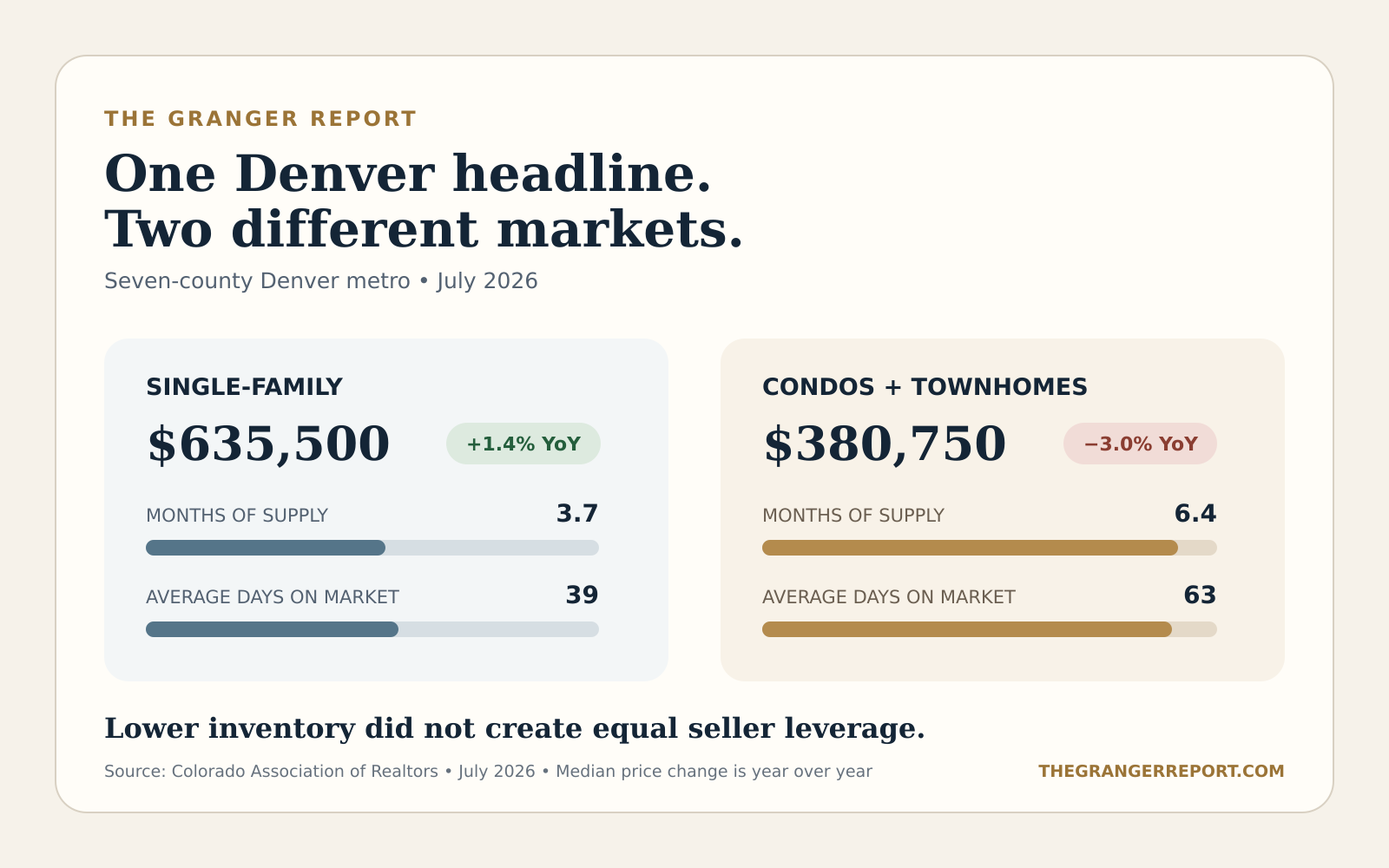
Single-family homes sold faster and carried less supply. Condos and townhomes took longer to sell, and their median price fell.
One Denver headline. Two different markets.
Lower inventory did not create equal seller leverage.
Underlying figures
| Metric | Single-family | Condos and townhomes |
|---|---|---|
| Median sale price | $635,500 | $380,750 |
| Year-over-year median-price change | +1.4% | -3.0% |
| Months of supply | 3.7 | 6.4 |
| Average days on market | 39 | 63 |
Inventory declined in both groups. The consequences were not the same.
For a single-family seller, fewer competing listings may have helped support pricing. For an attached-home seller, lower inventory was not enough to overcome softer demand. Nearly half of the attached homes that sold had reduced their price, and concessions appeared in almost two-thirds of attached sales.
The August REcolorado report adds a newer, broader view. Across an eleven-county Denver area, closed sales fell 13% from a year earlier while the median closed price stayed nearly flat at $595,000. New listings rose 4%, but pending listings fell 7%.
The two reports use different geographies and group properties differently, so they should not be joined into one continuous trend line. They do point toward the same practical lesson:
The headline gives you context. The property type, location, condition and competition shape the decision.
If you are selling, the useful question is not whether Denver is steady. It is whether buyers are choosing homes like yours, and what they are choosing instead.
If you are buying, a slower segment may create more room to negotiate. It does not make every home a bargain.
Faster work should create better service
Technology is supposed to make that interpretation easier.
In a CNBC Property Play interview, Coldwell Banker Realty CEO Kamini Lane described using AI to help select listing photos and prepare first drafts of property descriptions. She also argued that agents still bring judgment, neighborhood knowledge and candid advice.
That is a brokerage leader's view, but it creates a fair consumer test.
If software saves time, where does that time show up for you?
Does it produce a faster answer? A clearer comparison? A problem caught earlier? More time spent understanding what you are actually trying to accomplish?
The value of a tool is not that it exists. The value is what becomes easier to understand or do because of it.
That standard applies to the person using it, too. An impressive presentation is not the same as a sound recommendation. A long report is not automatically a useful one. More data only helps when someone can explain which part should change your decision.
More choice still needs an honest explanation
The same tension appears in the debate over listing access.
In an August 25 HousingWire opinion column, Craig Rowe questioned whether competition among brokerages, listing platforms and private-marketing strategies is making the consumer experience more confusing.
There can be reasons a seller considers limited exposure. There are also tradeoffs when fewer buyers can see a property or when different platforms do not show the same inventory at the same time.
The useful questions are concrete:
Where will the listing appear?
Who can see it, and when?
What is the strategy intended to accomplish?
What exposure or market feedback might the seller give up?
Buyers deserve the same clarity. What does the search include? What might it miss? Is the person helping you searching the full set of sources available to them?
Choice is valuable. But a choice is only informed when the tradeoff is visible.
An amenity can also be a privacy decision
Even a feature labeled as an amenity can require another question.
The National Association of Realtors recently reported on HOAs using surveillance cameras and automatic license-plate readers. Some buyers may appreciate the security purpose. Others may be uncomfortable having vehicles recorded as they enter and leave a neighborhood.
The article notes that governing documents may not explain the system or its policies. That does not establish what any particular Colorado association is legally required to disclose. It does mean a buyer may need to ask directly.
What information is collected? Who can access or share it? How long is it retained? Can it be used to enforce neighborhood rules?
The word security describes the purpose. It does not answer the privacy questions.
A signature does not create clarity by itself
The commission litigation is another version of the same story.
On August 19, the Eighth Circuit upheld approval of the major Sitzer-Burnett settlements. Two objectors filed rehearing petitions on September 1 and 2, so the appellate process remains active. Several related cases are still paused while that process continues.
Those legal details matter to the industry. The consumer questions are more immediate.
What services are included? What compensation are you agreeing to? Who may pay it? How long does the agreement last? How can it be changed or ended?
Compensation is negotiable. The explanation should be understandable before you sign.
More paperwork can document a choice. It cannot replace the conversation that makes the choice clear.
What I am watching next
The August Producer Price Index is scheduled for Thursday, September 10, and the August Consumer Price Index is scheduled for Friday, September 11. Both releases arrive at 8:30 a.m. Eastern.
Inflation data can influence bond markets and mortgage-rate expectations, but I would not turn one report or one market reaction into a housing forecast. I am watching whether borrowing costs materially change the payment conversation for Denver buyers, not whether one headline moves up or down.
The Granger takeaway
Real estate does not have an information shortage.
It has a translation problem.
A market statistic, an AI tool, a listing platform, a neighborhood camera and a representation agreement can all be useful. None of them should be accepted without understanding what they reveal, what they leave out and what decision they are supposed to improve.
More information is not the finish line.
Clarity is knowing what matters next.
What part of real estate would you like me to explain next?
Send me your question. It may become a future report.
Sources and reporting notes
Housing figures keep their own windows rather than one shared date: the Colorado Association of Realtors readings cover July 1 to July 31, 2026 across a seven-county Denver metro area, and the REcolorado readings cover August 1 to August 31, 2026 across an eleven-county Greater Denver Metro area. The two are not joined into a single trend line. Reporting, legal filings and the release calendar were reviewed as of September 9, 2026.
- Colorado Association of Realtors, July 2026 market report, published August 12, 2026. Seven-county Denver metro data.
- REcolorado, August 2026 Housing Market Reports, published September 4, 2026. Eleven-county Greater Denver Metro data.
- CNBC Property Play interview with Kamini Lane, dated September 1, 2026. AI passages were checked against the complete user-supplied automated transcript and paraphrased.
- HousingWire, "The real estate industry keeps protecting the transaction. Who is protecting the consumer?", opinion, published August 25, 2026.
- National Association of Realtors, "HOA Surveillance Cameras May Raise New Questions for Home Buyers", published August 31, 2026.
- Inman, "Where real estate's commission lawsuits stand after Sitzer decision", published September 8, 2026; cross-checked against the Eighth Circuit judgment.
- Settlement administrator, NAR settlement information site.
- U.S. Bureau of Labor Statistics 2026 release calendar, checked September 9, 2026.
This report is for general educational and informational purposes. It is not legal, financial or tax advice. Market data is deemed reliable but not guaranteed and should be verified before making a real-estate decision. Market conditions can change.